
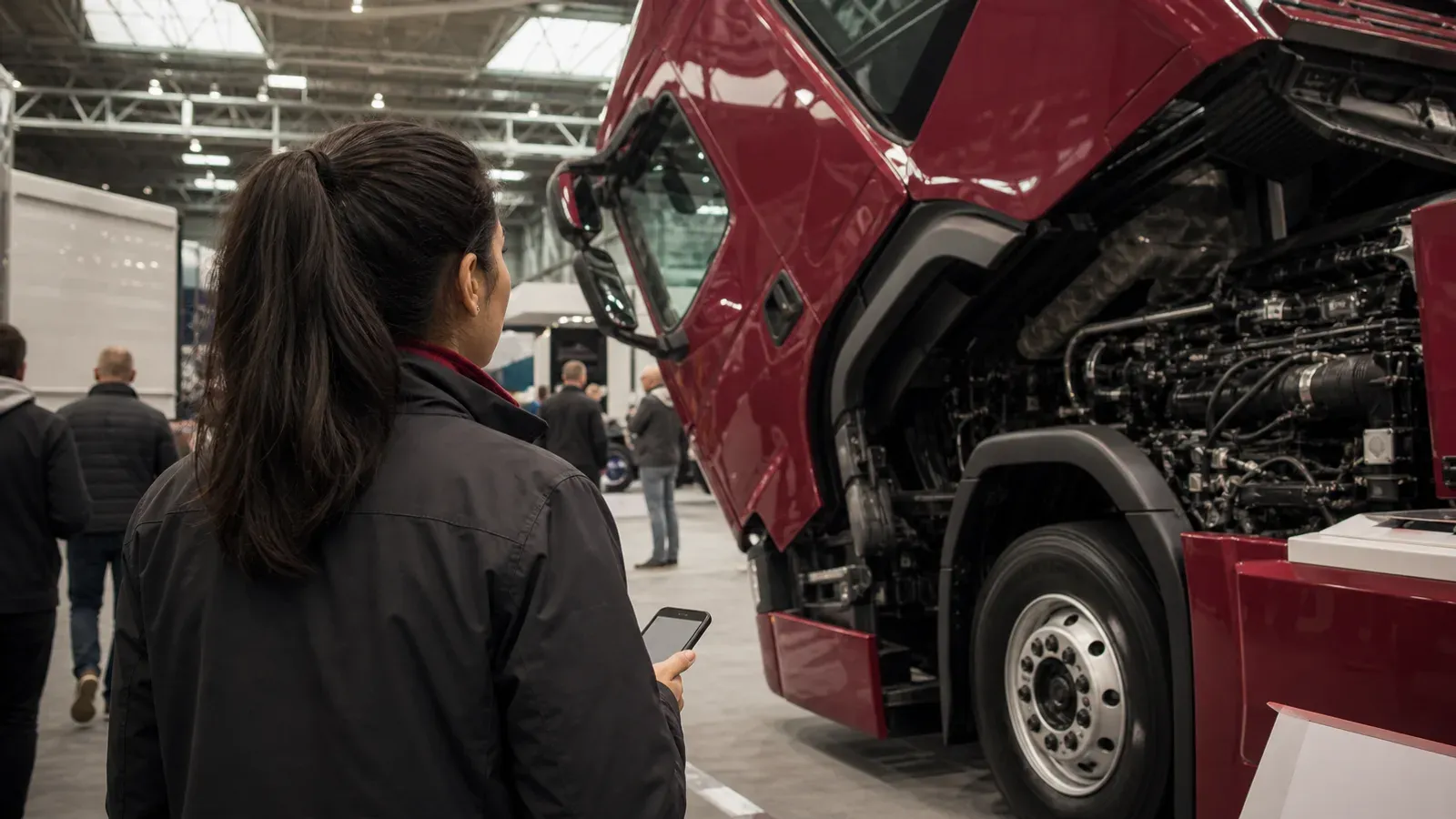
Walk the floor at the Commercial Vehicle Show and the first thing you see is trucks: new cabs, new drivelines, electric demonstrators with a queue to sit in them. They are worth seeing. They are also not where most haulage operations lose money.
The costly problems often start earlier, in the office, before seven in the morning. A plan built on a whiteboard that falls apart when a driver rings in sick. A route that looked fine on the map until the low bridge. A waiting charge nobody can prove. A POD that is still in the truck on Friday. This article is about how to use the show to find fixes for those, not just to admire the hardware.
What is the Commercial Vehicle Show?
The Commercial Vehicle Show, usually shortened to the CV Show, is an annual UK exhibition for the road transport industry, held at the NEC in Birmingham. It brings together vehicle makers, body builders, equipment suppliers and the software and compliance firms that serve operators. The next show runs from 20 to 22 April 2027, according to the official CV Show website. We refresh this guide each year ahead of the show.
Alongside the vehicles, recent shows have added dedicated areas for decarbonisation, driver safety and seminars. For an operator, that makes it one of the few places to compare a range of suppliers in a day.
Why the show matters more for operations than it used to
There was a time when the CV Show was mostly about vehicles. It still is, but more of the floor now goes on how fleets are run rather than what they run: planning tools, tracking, compliance systems and driver apps.
That shift follows the money. Average pre-tax profit across the Motor Transport Top 100 was 2.17%, according to the RHA’s Haulage Cost Movement 2025 report. At that margin, a slightly better truck is a small gain. A day that runs to plan, with every extra billed and every POD back, is a bigger one.
Many operations also sit in an in-between state. Tracking was added one year, a checks app another, invoicing still runs from a spreadsheet. Each tool helps on its own. Together they mean the same job lives in several places, and the gaps are held together by people ringing each other. That is the problem worth bringing to the show.
Seven upgrades worth looking for
Each upgrade below comes with the one question that separates a real answer from a sales answer.
1. Planning that absorbs change during the day
Plans change. Customers move slots, vehicles run late, a driver rings in sick. The issue is not change; it is a plan that has to be rebuilt from scratch every time. Look for planning where moving a job, inserting cover or reallocating a leg is a quick adjustment, and where the driver sees the change without a phone call.
Ask: “Show me what happens on screen, and on the driver’s phone, when I move a job at 10am.”
2. Routing that knows the vehicle
A route that suits a car can be a disaster for a 4.9-metre trailer. Standard navigation apps do not know your vehicle’s height, weight or length unless they are built to. Look for routing that holds those dimensions against the vehicle and trailer, and warns on low bridges.
Ask: “Where are my vehicle’s dimensions stored, and what happens when the trailer changes mid-shift?“
3. Waiting time on record
Time held at a customer’s gate is one of the easiest costs to lose. Without an arrival and departure record, a waiting charge turns into an argument. Look for driver status updates (arrived, on site, complete) that are timestamped automatically, and a way to flag when a job overruns its allowed time on site.
Ask: “How would I prove to a customer that my driver waited three hours last Tuesday?“
4. Fewer empty miles through better visibility
GB-registered HGVs ran empty for 30% of their distance in the 12 months to March 2026, according to Department for Transport figures. Some of that is unavoidable. The rest is often a visibility problem: the planner cannot see where a truck will be this afternoon, so the backload goes to someone else.
Ask: “Can I see, on one screen, which of my trucks will be near a collection point later today?“
5. One flow for the driver
Drivers often juggle job details from one place, updates by phone, checks on a pad and PODs on paper. Every handoff is a chance to miss a step. Look for one app that holds the jobs, the walkaround check and the proof of delivery, and that keeps working when the signal drops.
Ask: “Can I see the driver side on a phone, with the signal switched off?“
6. Invoicing from the delivered job
Invoicing often lags the work by days because paperwork has to come back, be checked and be keyed in. Look for a system where the job, its rate and its POD come together, so the invoice can go out as soon as the proof is in.
Ask: “Walk me from a delivered job to a sent invoice. How many times is anything typed?” Our article on the real cost of delayed haulage invoicing shows why the answer matters.
7. Knowledge that does not live in one head
Many operations rely on one or two experienced planners who know which routes work and which customers need a call first. That knowledge is valuable and fragile. Look for somewhere to hold customer instructions, site notes and driver skills so that cover staff can use them.
Ask: “If my senior planner were off for a fortnight, where would a new starter find what they know?”
Your show-floor scorecard
Take this into the hall and score each stand you visit against the same seven questions: 0 for no answer, 1 for a partial answer or a promise, 2 for something shown working on screen.
| Upgrade | Question to ask | Stand A | Stand B | Stand C |
|---|---|---|---|---|
| 1. Plans absorb change | What happens when I move a job at 10am? | |||
| 2. Truck-aware routing | Where are my vehicle’s dimensions stored? | |||
| 3. Waiting on record | How would I prove a three-hour wait? | |||
| 4. Fewer empty miles | Can I see where trucks will be this afternoon? | |||
| 5. One driver app | Can I see the driver side offline, on a phone? | |||
| 6. Invoice from the POD | How many times is anything typed? | |||
| 7. Knowledge shared | Where would a new starter find what my planner knows? | |||
| Total (out of 14) |
Getting value from the day
Before the show. Spend a week noting where time goes: the calls, the retyping, the chasing. That list becomes your brief. Check the exhibitor list on the organiser’s site and shortlist five to ten stands that address your top two or three problems. Bring one real job, with its paperwork, to test each of them against.
On the floor. Ask to see the driver side on a phone, not on a big screen. Run your own job through the demo rather than the supplier’s sample data. Ask which tracker and accounts versions they support today and what each connection costs, and get the answer in writing.
After the show. Score every stand on the same sheet while it is fresh. Book a follow-up with the two or three that scored highest, using your own data. If you are weighing up a transport management system, our plain-English guide to what a TMS is and the HaulierMagic platform overview are useful background before that second conversation.
HaulierMagic is built around this order-to-invoice flow, and you do not need to wait for April to put it through the same seven questions.
Most haulage businesses do not have a vehicle problem. They have an operations problem: a day that leaks time and money between the plan, the truck, the customer’s gate and the invoice. The Commercial Vehicle Show will not fix that on its own. Go with your list, score every stand the same way, and it is a day well spent finding what will.